







Click to Skip Ahead
The ability of a pet snake to form emotional attachments is extremely limited. They will not display affection or emotions as cats or dogs do, but that doesn’t mean they cannot become accustomed to the company of their owners. Pet snakes are solitary and instinct-driven creatures, and although most can become tolerant of gentle handling, experts say that you’ll have to work patiently to achieve that level of comfort.
Let’s find out whether pet snakes can be affectionate to their owners.

Do Snakes Get Attached to Their Owners?
Snakes and other reptiles are not capable of emotional attachment to humans. They may become more tolerant of handling and familiar with routine interactions, but they remain instinctive and not emotionally bonded in the way mammals or birds can be.
At one time, the main concern of experts was that, unlike mammals and birds, snakes do not have a sufficient number of facial muscles to form expressions, and they don’t even have eyelids. They cannot communicate or show affection with body language either.
If you were to abandon your pet, it would most likely not miss you and simply go about its business.
While they may not get attached, snakes are capable of becoming calm and comfortable in their owner’s presence.

How Do Snakes Show Affection?
Snakes do not show affection in the way mammals do, but some of their natural behaviors are often misinterpreted as signs of love or attachment. For instance, when a snake rubs against an object, moves its head, or coils around a person, it’s not showing affection; it’s responding to its environment. These actions are usually related to exploration, seeking stability, or regulating body temperature.
Many owners assume that when a snake wraps itself around their arm or neck, it’s showing trust or affection. In reality, this behavior is instinctive; the snake is simply looking for security or warmth and using its muscles to anchor itself to something solid.
While snakes may learn to tolerate gentle handling and become calm in their owner’s presence, this comfort stems from habituation and a sense of safety, not emotional affection.
Do Pet Snakes Like to Be Handled?
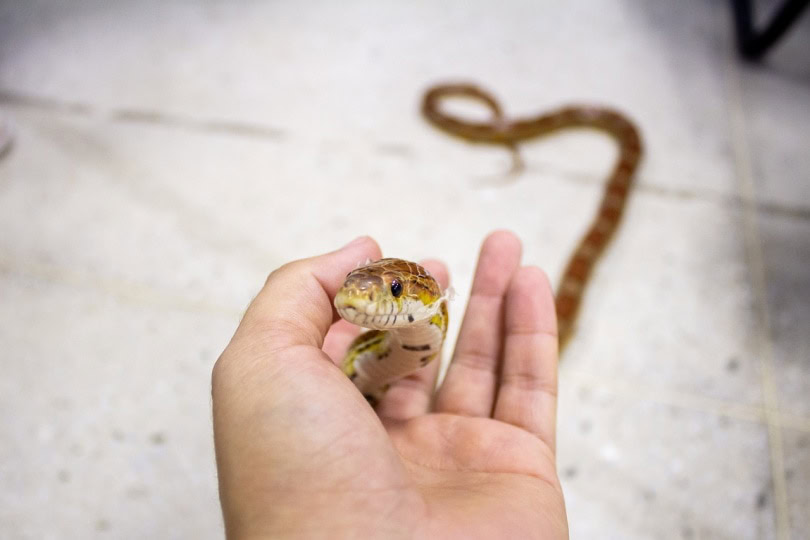
Whether your pet snake will tolerate handling depends on its species, temperament, and level of habituation. Some snakes like corn snakes or ball pythons generally tolerate handling well when acclimated. Others, such as arboreal or wild-caught species, may remain defensive or stressed.
You should never handle a snake immediately after it has eaten, or it might regurgitate its meal due to stress. If your snake shows signs of stress or defensiveness (such as hissing, striking, or rapid tongue flicking), it’s best to give it space and avoid touching it because it may bite you.
Snakes are not meant to be handled without care. When you do begin to handle it, support the snake’s entire body without restraining its head or tail. Never grip tightly, and allow the snake to move freely through your hands to prevent injury or fear responses.

How Do I Know My Snake Is Happy?
Snakes are not known to experience happiness, or even contentment, as mammals do, but they can display signs of good welfare and comfort. Indicators of a healthy, comfortable snake include normal feeding behavior, regular shedding, consistent activity levels, and exploration of their enclosure.
A well-adjusted snake will appear calm, alert, and responsive, and it will readily resume normal behavior after handling.
Do Snakes Know Their Name?
Snakes cannot recognize their names or understand spoken words. They lack external ears and the structures needed to perceive most airborne sound frequencies, including human speech. Instead, snakes detect low-frequency vibrations and pressure changes through the jawbone, skull, and body, which transmit signals to the inner ear.
While they can’t learn their name, snakes may associate certain vibrations or environmental cues, such as movement near their enclosure, with predictable events like feeding or handling. Consistent husbandry routines help them feel secure through familiar patterns rather than verbal cues. For example, if you gently tap the terrarium’s glass before every feeding, your snake may learn to associate that vibration with food, responding through increased alertness or exploratory behavior.
What Emotions Can Snakes Feel?
Reptiles are capable of basic affective states, such as fear, aggression, or a form of comfort when environmental needs are met.
They do not experience complex emotions like love, joy, or attachment. “Contentment” in snakes reflects a state of low stress and proper thermoregulation, not an emotional feeling comparable to mammalian happiness.

How Do You Tell If a Snake Likes You?
Snakes do not “like” or “dislike” people, but they show tolerance or stress through body language.
If your snake is relaxed, tongue-flicking normally, and moving calmly, it is comfortable.
If it’s trying to escape, freezing, hissing, or striking, it is fearful or defensive.
Are Snakes Intelligent?
Snakes have limited cognitive complexity compared to mammals, but they demonstrate instinctive problem-solving abilities, spatial memory, and learning capacity. Their brains are specialized for efficient sensory processing and survival behaviors, such as hunting, thermoregulation, and predator avoidance. While they lack the brain structures associated with social or emotional intelligence, their adaptability and success across diverse environments reflect a form of intelligence finely tuned to their ecological needs.
In other words, snakes are intelligent within their own evolutionary context; they have survived and adapted for millions of years because their behavior and physiology are perfectly designed for the roles they play in nature.
How Do You Bond with a Pet Snake?
To develop your snake’s trust, you must first understand their species-specific behavior and learn how to handle it calmly and consistently.
Snakes prefer secure, predictable environments and become stressed by frequent disturbance.
Take enough time to allow your pet snake to become familiar with your scent and movements. Handle your pet snake only when it is alert and calm, and always avoid sudden movements or loud vibrations. Consistent, gentle handling routines can reduce fear.

Do Pet Snakes Feel Love?
Pet snakes are reptiles and lack the limbic structures necessary for emotional bonding or love. However, since many pet snakes are fed and given physical contact by their owners, they may associate human presence with safety, warmth, or satiation, which may create the appearance of comfort in your presence. Even if they do not experience “the love” that humans know, they may tolerate and even seek warmth or stability from handling, but this is instinctive, not emotional affection.
Conclusion
You may have a pet snake and wonder how to show it affection or whether your snake feels comfortable with you. That’s why we’ve compiled this ultimate guide of questions that people commonly ask about their snakes! Understanding your snake’s natural behaviors, body language, and environmental needs is the foundation of responsible reptile care.
While snakes do not experience or express affection in a human sense, proper husbandry, gentle handling, and consistent, calm interaction can help them become trusting and relaxed in your presence. A well-cared-for snake will appear healthy, alert, and at ease; not stressed or defensive.
If you’re ever uncertain about your snake’s behavior or health, consult a veterinarian experienced in reptile medicine for individualized guidance and support.
- You might also be interested in: Best Heating Pads for Snakes & Reptiles: Reviews & Top Picks
Featured Image Credit: glicafernandaalmeida, Pixabay









2 Responses
This article was goes I’m always wondering if I’m making my ball python ,Jake, happy. I have a fenced in garden are that I let him explore (never unattended). Sometimes he slithers around and under the different plants but sometimes he just hides under one. I’m wondering if he enjoys this exercise time or if it’s scaring him. He has a 40 gallon tank right now that I keep in a bay window. I think it’s getting too small for him and am trying to find a snake experienced contractor to build a huge vivarium into the window. Any suggestions would e greatly appreciated. He is my first snake, I got him 5 months ago from his original owner, he is 7. How old do ball pythons typically live, I’ve read different opinions. Thank you! PS I live in the US in Connecticut
Dear Cheryl,
thank you for your comment and sorry for a bit of a late reply. It is clear that you are trying your best to take a good care of your ball python, which is always great to hear! With that being said, the ball pythons are known to be agoraphobic, as most of the snakes, so large open spaces can be stressful for them. Letting your snake explore your garden isn’t wrong, just make sure they have plenty of easily accessible hiding spots and they don’t have to crawl over the open space. It could be also dangerous due to the flying predators.
As far as your other questions go, we would like to suggest you take a look at our other posts about ball pythons, where we are sure you will find all the information you need:
– How to Take Care of a Ball Python: Vet-Reviewed Facts & Advice
– Essential Ball Python Supplies to Get You Started: Vet-Reviewed Guide
– How Long Do Ball Pythons Live? Average Lifespan, Data & Care
If you would still have more questions or concerns, please don’t hesitate to set-up an appointment with one of our vets on PangoVet.com or send us an email to [email protected] so that our reptile specialist can arrange an appointment directly with you.