







Click to Skip Ahead
If you’ve decided to welcome a pet rat into your home, you may have come across different terms like “Dumbo rat” and “Fancy rat” — and wondered what sets them apart. The key thing to know is that all domesticated pet rats belong to the same species, Rattus norvegicus domestica, and are collectively known as fancy rats.
Fancy rat is a general term that includes all pet rat varieties, including Dumbo rats. In fact, Dumbo rats are fancy rats, they’re simply one of several varieties recognized by organizations like the American Fancy Rat & Mouse Association (AFRMA) or the National Fancy Rat Society (NFRS) pages, alongside others such as standard, rex, hairless, and tailless rats.
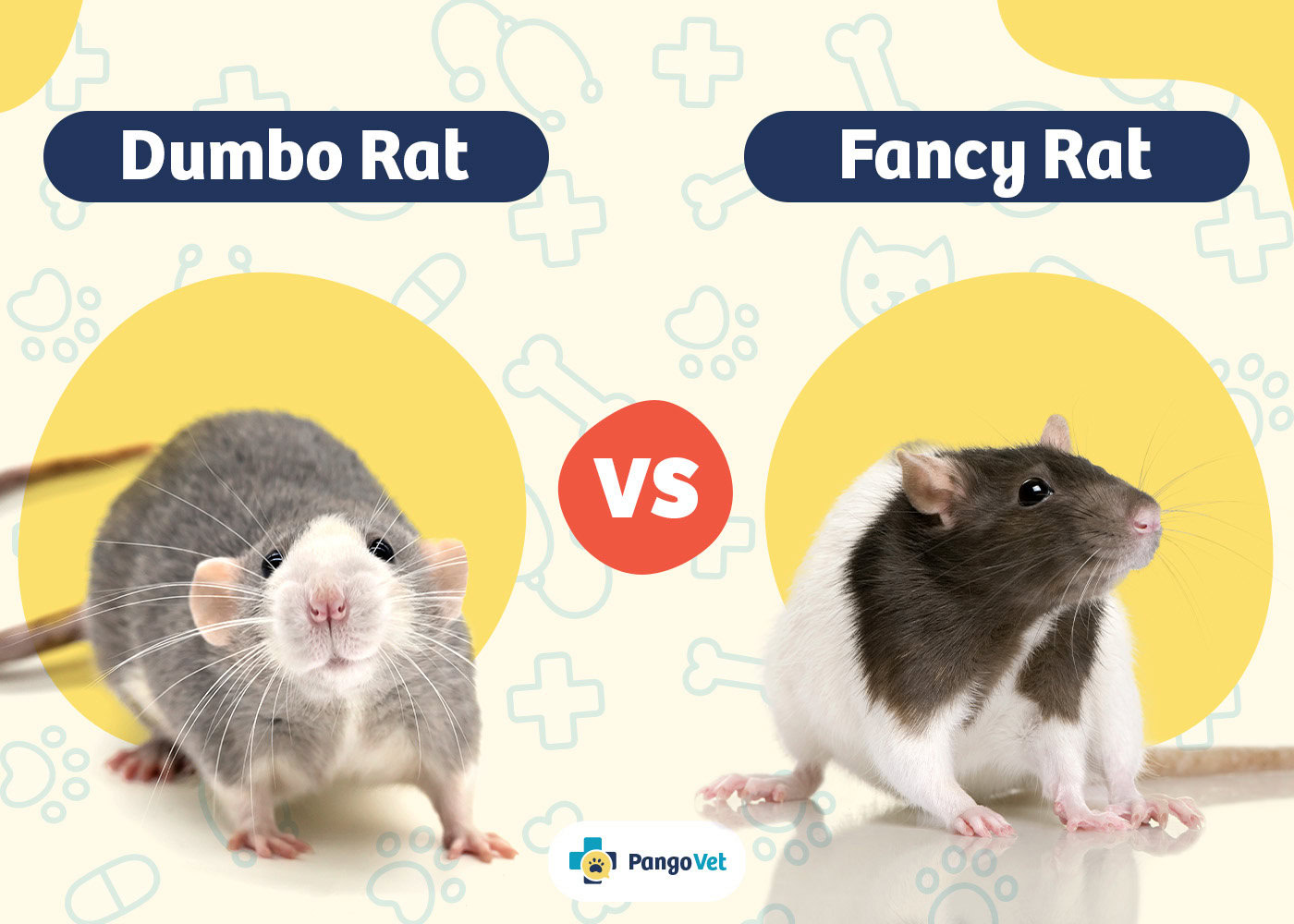
While Dumbo rats and other fancy rats are the same species and share similar traits when it comes to care, health, and temperament, there are a few visual differences worth exploring.
Let’s find out a little more about both of these adorable rat varieties!

Visual Differences

At a Glance
- Average size (adult): Body 9–11 inches, tail 7–9 inches
- Average weight (adult): 0.5 pounds–1.5 pounds
- Lifespan: 18–36 months
- Exercise: 1+ hours a day
- Grooming needs: Low
- Family-friendly: Yes
- Other pet-friendly: Sometimes
- Trainability: Yes
- Average size (adult): Body 9–11 inches, tail 7–9 inches
- Average weight (adult): 0.5 pounds–1.5 pounds
- Lifespan: 18–36 months
- Exercise: 1+ hours a day
- Grooming needs: Low
- Family-friendly: Yes
- Other pet-friendly: Sometimes
- Trainability: Yes
Dumbo Rat Overview

Dumbo rats are sweet-natured and easy to handle, and those large ears make them downright adorable to look at, too! Of course, it’s no surprise that their name is inspired by the fictional elephant, Dumbo, with those large, circular ears.
As mentioned before, Dumbo rats are considered a variety of the fancy rat, so both are the same species. The low-set and large ears of the dumbo rat are due to a gene known as “dumbo”. This recessive gene is only expressed as a physical characteristic when the rat inherits two genes, one from their mother and one from their father. It’s thought that the dumbo rat was first developed in Northern California around 1991.
Let’s take a look at more details about the dumbo rat.
Personality & Character
Dumbo rats are friendly and outgoing, and usually love interacting with people. They’re sociable with other rats too, so it’s essential to keep two rats together. Most breeders will be happy to provide a pair of siblings, and this is usually the best way to make sure your rats get along well. Of course, spaying or neutering is essential to make sure you don’t end up with an accidental litter of baby rats!
Rats are clever and love spending time out of their cages exploring their homes. Some owners say that male dumbo rats can be more relaxed and spend most of their time sleeping. Females may be a little more active. But either way, rats love to nap!
Health & Care
Dumbo rats, like all pet rats, can suffer from a few different health conditions, with the most common being respiratory problems and mammary tumors in females. Regular veterinary check-ups and early spaying (when appropriate) may help reduce some health risks.
Dumbo rats should be housed in a well-ventilated wire cage at least 2 feet square, but the bigger, the better. Avoid wood shavings such as pine or cedar, as they can release aromatic compounds that may be dangerous. Instead, opt for paper-based or Aspen bedding. Be sure to provide plenty of hiding spots, soft nesting material, and vertical space or accessories for climbing and enrichment. A balanced diet is essential. Dumbo rats should be fed high-quality pellet food formulated for rats. This can be supplemented with small amounts of fresh vegetables and occasional sources of protein, such as cooked lean meat or boiled egg.

Breeding
It’s not recommended to breed your own dumbo rats at home. Rat breeders will be experienced at knowing how to breed healthy rats, and the cost of baby rats is low enough that there are no financial benefits to trying to breed your own.
Suitability
Families looking for a playful and outgoing rodent pet will enjoy dumbo rats. They will need a large cage and at least an hour of exercise outside of their cage every day. They’re intelligent and affectionate and love interacting with humans. These sociable rodents will be happiest when kept with another rat for company.
They can be easier to handle than smaller rodents, like hamsters, and tend to be awake during the day, meaning more playtime!
Fancy Rat Overview
Fancy rat is the general term that includes all pet rats. Unlike the dumbo rat, fancy rats have small ears that are high up on their heads. You may sometimes see fancy rats called “top-eared” rats as another way to differentiate them from their larger-eared cousins.
Unlike the dumbo rat, fancy rats have small ears that are high up on their heads. You may sometimes see fancy rats called “top-eared” rats as another way to differentiate them from their larger-eared cousins.
Fancy rats are descended from wild-caught rats that were tamed in the 18th century. By now, the domestic rat is so far removed from their wild cousins that there are significant differences when it comes to appearance and coat color.

Personality & Character
Fancy rats are intelligent and outgoing and enjoy interacting with their human families. They will happily spend time on your lap or sniffing around the house while you do chores. Some professional animal trainers say that fancy rats are one of the easiest and most rewarding animals to train, so you can have fun teaching your rat a few tricks. They can be trained to use a litter tray, come when called, sit, stay, and more!
Rats are extremely sociable and are used to living within family groups. Most breeders will recommend taking two baby rats home at the same time, so they can bond with each other and keep each other company. These should both be the same sex or be spayed and neutered as early as possible in order to prevent unwanted litters—and there can be up to 20 babies per litter!
- Related Read: How to Choose the Right Cage Size for Pet Rats
Health & Care
Fancy rats are generally healthy pets, although they can suffer from two main health issues that can require medical care. Respiratory illnesses are relatively common, as are mammary tumors in unspayed females. The only downside is that fancy rats only live for around three years, which doesn’t feel like long enough when they’ve become a treasured member of your family!
Fancy rats need an enclosure of at least a 2-foot square for a pair of rats. Wire cages are best, as long as they have a solid base. Rats love climbing and burrowing, so providing plenty of places for your rat to hide and climb is essential.
Paper bedding is best, and cedar bedding should never be used because it can be very toxic to rats. Wood bedding made from aspen is sometimes advertised, but in our opinion, it should also be avoided.

Breeding
Breeding your own fancy rats at home is not recommended. If you have a male and female pair, then they’re often from the same litter, in which case, you run the risk of the babies suffering from genetic illnesses due to inbreeding.
Professional rat breeders will carefully select their breeding rats for health and temperament, and rat kittens aren’t expensive, so this is definitely a job best left to the pros!
Suitability
Families looking for an intelligent and outgoing small pet will enjoy fancy rats. They are fun and love to play, meaning they can be rewarding to keep and care for. They are happiest kept as a pair, but will still need plenty of time outside their cage interacting with their human families.
They’re super smart, so set yourself a few training challenges and you’ll be impressed by what your new pets can learn!
Which Breed Is Right for You?
The dumbo rat is a variety of pet rat, and fancy rat is the general term for all pet rats, regardless of their coat or other characteristics. All pet rats belong to the same species, the Norway rat, Rattus norvegicus domestica. The main feature of the dumbo rat is the position and size of their ears. Dumbo rats are a more modern variety and have been bred to have low-set ears, which stand out prominently from their heads. They can be found in any of the huge range of coat and eye colors that the fancy rat is found in.
Fancy rats have smaller ears, which are set higher on their heads. You may see them called “top-eared,” which is just another way to distinguish them from their dumbo cousins. Fancy rats come in many different coats and eye colors, so whatever pattern you prefer, you’re bound to find an adorable rat to match!
In terms of their care, health, and personality, the dumbo rat and the fancy rat are exactly the same. So, no matter which one you prefer in terms of their appearance, you can expect their needs to be the same. Rats love playing, hanging out with their owners, and of course, napping!
Featured Image Credit: Top – jnightfall, Pixabay | Bottom – Ezume Images, Shutterstock