







Click to Skip Ahead
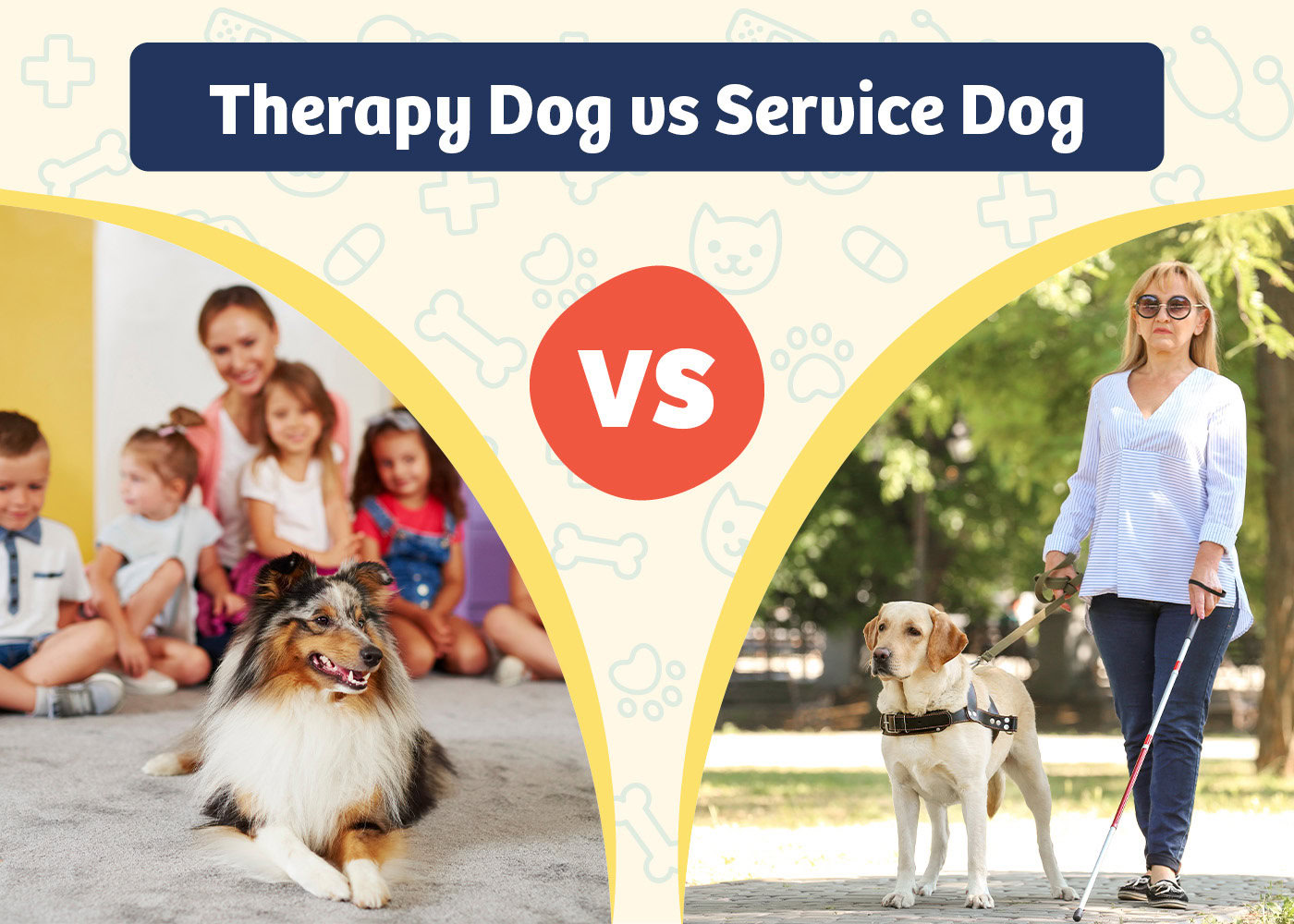
For thousands of years, dogs have aided and collaborated with people in countless tasks, including farming, hunting, protection, and more. Two of the most impressive examples in recent times are therapy and service dogs, which are invaluable to many individuals. However, many people confuse the two, using the terms service dog and therapy dog interchangeably, when they are actually very distinct roles, each performing different functions and having different legal provisions.
In this article, we discuss the differences between therapy and service canines, as well as the jobs that each type of dog performs in the lives of those who need them. You’ll know which one is best for you once you’ve finished reading.

Overview of Therapy Dogs
Many people are curious about the first therapy dog, and giving an appropriate answer to that question is quite challenging. There was one candidate from the 1960s1 when a clinical psychologist described therapy dogs to the American Psychological Association. Boris Levinson used his Golden Retriever named Jingles to help children with autism.
Therapy dogs are trained to provide comfort and support to many different people in many different settings. They are usually very friendly, calm, predictable, and adaptable. Most of them reside with their owners, with both certified to work as a team. They typically are registered with an organization that will arrange for dogs and their owners to visit particular places and interact with the people there.

What Does a Therapy Dog Actually Do?
There is no requirement for therapy dogs to perform any specific tasks. They must be obedient, friendly, and able to safely interact with both children and adults in settings such as hospitals, nursing homes, schools, libraries, or mental health facilities. Their primary role is to provide companionship, affection, and support.
It has been proven that simply spending time with therapy animals in these kinds of scenarios can help people feel less anxious and depressed. The animals will boost the spirits of those they interact with and make them more willing to engage in their own recovery processes.
Therapy Dog Requirements
A therapy dog must fulfill certain criteria to be registered and certified. The American Kennel Club (AKC) recommends that all dogs pass the Canine Good Citizen (CGC) test before registration to become a therapy dog. While there is no specific age requirement, most organizations require the dog to be at least one year old. It is also much easier if you train dogs early in life. Their handling abilities, manners, and demeanor then have to be evaluated by an identified organization. Then, the organization will commonly observe the animal during actual therapy sessions.
If you’re interested in learning more, you can find out what opportunities are available by searching the internet for the phrase “therapy dog training” and the name of your city or town. You can also contact the facility you have in mind by phone or email to learn about their acceptance procedures.
What Breed of Dog Is Used for Therapy?
With training, any breed of canine can become a therapy dog. Standard Poodles, Golden Retrievers, Labradors, and St. Bernards are among the most common large dogs used for this purpose, but if the person and the animal only share a small space, breeds like Mini Poodles and Pomeranians are wise options too. Low-shedding breeds like Poodles and Poodle-crosses are quite popular as they are often better tolerated in clinical environments, but ultimately, it is the temperament and training that are important, not the breed.

Where Are Therapy Dogs Allowed to Go?
Therapy dogs can visit many settings. These are typically areas where people feel alone, vulnerable, or have a tough time, such as nursing homes, hospitals, special schools, disaster recovery areas, etc.
How To Get a Therapy Dog
Most people are glad to certify their current dog as a therapy animal. Some others decide to purchase one from a reputable breeder or trainer. In addition, you can choose to adopt a pet and later train them to perform therapy work. There is no “right” or “wrong” way to go about it.
- Being able to assist a variety of individuals and in a variety of settings
- Any individual undergoing stress or with a mental illness who doctors believe would be beneficial can use these dogs as a resource
- Less rigorous training than service dogs
- Cannot access locations where pets are prohibited

Overview of Service Dogs
Service dogs were legally recognized in the United States in 1990 with the passing of the Americans with Disabilities Act (ADA). These canines, sometimes referred to as assistance dogs, are individually trained to work or perform tasks for people with disabilities. A disability is a mental or physical impairment that substantially limits a person’s ability to perform one or more main life activities.
Although police, cadaver, and search-and-rescue canines are all types of working animals, service dogs are very distinct from them.

What Does a Service Dog Actually Do?
There are many different kinds of service dogs, and some even have more than one function. Before working with a person, they must complete rigorous training courses. Listed below are a few varieties of service dogs:
- Guide dog – aka ‘Seeing Eye Dog’ for the blind or visually impaired
- Hearing assistance dogs
- Mobility assistance for people who use wheelchairs or have other mobility limitations
- Seizure alert and response
- Diabetic alert dogs that identify blood sugar lows and highs by scent
Service Dog Requirements
Service dogs that help a person with a disability must receive specialized training to perform specific tasks, and must be under the control of a handler. The ADA requires them to be leashed or tethered unless the person’s disability prevents he use of these devices or they impede the animal’s safe, efficient completion of tasks. In these situations, handlers must continue to exert control over the dog using a signal, voice, or other practical management methods.
In most cases, service dogs must be strictly toilet trained to go on command.
What Breed of Dog Is Used for Service?
You can find service dogs from very tiny to very large. The dog’s size will allow them to perform their duties comfortably and effectively. A Papillon, for instance, would make a great hearing canine but is inappropriate for pulling a wheelchair.
Labrador Retrievers, Golden Retrievers, and German Shepherds are the breeds most commonly trained as guide pups. Canines with the height and strength to help with mobility include Great Danes, Saint Bernards, and Bernese Mountain Dogs.
Poodles, which come in Standard, Toy, and Miniature types, are exceptionally adaptable. While a large Standard Poodle can learn to turn on lights and carry items, a Toy Poodle can start early scent training sessions to prepare for the job of detecting blood sugar fluctuations.

Where Are Service Dogs Allowed to Go?
According to the ADA, people with disabilities have a right to broad public access to their service animals. Unless there are legitimate safety concerns, they can go anywhere open to the public, such as buses, restaurants, stores, and more. They are allowed in most areas in a hospital, excluding, for example, an operating room or burn unit, where their presence may compromise sterility. In places where they’re allowed, the handler must always ensure the animal is well-groomed and controlled with a leash or harness. Any harm or mess caused by the dog is the owner’s responsibility.
How To Get a Service Dog
People with physical or psychological health conditions can live much more easily with the help of service animals, and the easiest way for most people to adopt a service pup is through an identified organization. Fortunately, many specialize in training service dogs all over the United States. They will train a canine for a particular job, for example, a psychiatric service dog (PSD), a seeing-eye dog, or other types.
Some organizations give free service animals to people with disabilities, while others might offer financial aid to those who need a service dog but cannot afford one. Some others may charge a fee for a trained canine.
- Make the lives of people with disabilities safer and much easier
- Allowed in public places where dogs are typically prohibited
- Protected under federal law
- No additional housing fees
- Housing protection
- Long waiting lists and high costs associated with obtaining one
Can Police Ask for Service Dog Proof?
The police are not allowed to request documentation of service animals under the law. If a police officer stops you and asks for service dog proof, you can politely respond that the ADA does not require service dogs to have any identification or certification. You don’t have to, but you can give them details about your dog if you want to.
What People Can Ask You About Your Service Dog
Staff members may only ask about the following two things about a service animal:
(1) Is the dog a service animal needed due to a disability?
(2) What tasks has the dog been taught to perform?
As mentioned above, staff members are prohibited from requesting documentation about the canine, asking them to perform duties, or inquiring about the person’s disability. These animals also don’t need to wear an ID tag, a vest, or a specific harness. However, using a vest or harness that identifies a dog as a service animal can make things a little easier when entering public spaces, and also lets people know that the dog is working and should not be approached or petted.
- When people with disabilities need assistance in everyday life
- Help to pull a wheelchair
- Protect someone who is having a seizure
- Remind an individual with mental illness to take their prescription
- Detect low or high blood sugar in diabetic patients
- Detect the onset of an epileptic seizure
- Emotional support for adults and children with anxiety
- Providing companionship in care homes
- Improving emotional wellbeing of patients in hospital
- Help with trauma recovery for individuals or groups
- Support for people with conditions like autism spectrum disorder
Conclusion
While service and therapy dogs improve many people’s lives, they are not the same thing, and the distinction is more than just semantics. Each has an important role to play, with significant differences between their responsibilities, access privileges, and required training. Hopefully, this article has shed some light on the differences between these two kinds of dogs and helped you decide which is right for you.
See also:
- Allergy-Detection Service Dogs: What They Are & What They Do
- Service vs. Therapy vs. Emotional Support Dog: The Main Differences
Featured Image Credit: Top – Ryan Stone, Unsplash | Bottom – Shine Caramia, Shutterstock