







Though cats and dogs are the most popular pets around the world, birds aren’t far behind. Birds are high on the list of the most popular pets globally. Their antics, songs, vivid colorations, and ability to mimic human speech are traits that add to their appeal. In addition, their longevity can be a perk as well.
If you’re considering adopting a parrot, we’ve compiled some key information that might help you with your decision and perhaps help you narrow down the species to adopt as well. Read on!

Before You Adopt
There is no doubt that parrots make fascinating pets. However, before you rush into adopting a parrot or two, it is important to be mindful of a few factors.
Considerations before adopting a parrot:
- Ensure that it is legal to adopt the species you are interested in where you reside.
- Some jurisdictions might require a license to keep parrots. Therefore, though they may be legal to own, you would have to ensure that your license is valid. If you are in the US, refer to state laws before adopting a pet. Elsewhere, refer to the laws of your country or territory.
- Many parrot species are included in CITES (Convention on International Trade in Endangered Species of Wild Fauna and Flora), which regulates or restricts their trade across borders. This means that they require legal documentation before they can be adopted.
- Thoroughly research your species of interest and their requirements as pets, your breeder, rescue center, or the place you will adopt your parrot from.
- If you own other pets, especially predatory pets, you should seriously reconsider before adopting a parrot. Birds are prone to stress from the mere presence of a predator, and the risk of housing prey and predator species together isn’t worth it.
- Ensure you have information about your closest exotic or avian veterinarian.
- Never adopt a wild-caught animal or release your pet into the wild.
- While some parrot species are often described as “beginner-friendly,” no parrot is truly an easy pet. All parrots are exotic animals with complex physical, behavioral, and psychological needs that differ greatly from dogs and cats. Even smaller species, such as budgies and cockatiels, require daily interaction, environmental enrichment, flight or active movement, specialized nutrition, and access to avian veterinary care to remain healthy.
- Prospective owners should also understand that parrots naturally chew household items, vocalize frequently, and pass droppings many times throughout the day. These behaviors are normal and unavoidable aspects of parrot biology, not training failures. Homes must be appropriately bird-proofed to prevent property damage and accidental exposure to toxins or hazards.
- Parrots should not be confined to cages for the majority of the day. While a properly sized cage is necessary for sleeping, safety, and rest, parrots require several hours of supervised out-of-cage activity daily to maintain muscle strength, joint health, and psychological well-being. Long-term confinement without adequate movement can contribute to obesity, muscle atrophy, and degenerative joint disease over time, as well as self-mutilation and feather plucking due to boredom and anxiety.
- Routine or excessive wing clipping may interfere with balance, confidence, and normal musculoskeletal use, particularly in young or developing birds. When wing clipping is considered, it should be evaluated on an individual basis and discussed with an avian veterinarian, as flight plays an important role in both physical and mental health.
- Many parrots are surrendered each year due to unmet expectations regarding their lifespan, noise level, mess, and social needs. Thorough research and realistic preparation before adoption are key factors in reducing rehoming and improving long-term welfare outcomes for these birds.
The 10 Popular Types of Pet Parrots
Before reviewing individual species, it’s important to dispel the myth that, compared to animals like cats and dogs, parrots are easy pets. In fact, the specialized care needed by parrots go well beyond those of dogs or cats, and often require more research, and more complexity than many people realize. The difficulty ratings below simply compare parrot species to each other and do not mean that any parrot is low-maintenance or easy to care for.
1. Budgerigar/Budgie
| Cage Size (minimum) | 36 inches (length) x 24 inches x 24 inches Approximately 92 x 61 x 61 cm |
| Cage Bar Space | ½ inch (12 mm) |
| Difficulty | Beginner-Appropriate |
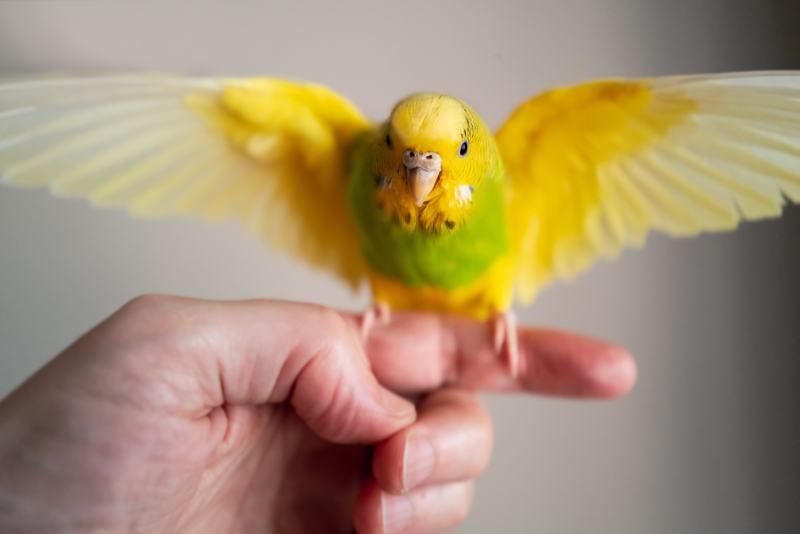
The budgerigar is the most popular pet bird in the world, and for good reason. These colorful parrots are small and relatively easy to care for but pack quite the energetic and vibrant punch with their personality.
The unique charm of budgies is perhaps their high level of energy. It is best if their cage is long, rather than tall, as they are very active and prefer to fly horizontally. Adult budgies can often be easily sexed by the color of their cere, or the area around their nostrils. Males have a blue cere, while females commonly develop tan to brown ceres, especially during breeding conditions.
The world record for a bird with the largest vocabulary is held by a budgie. The individual in question was Puck, a male budgie who passed away in 1994. It was confirmed that he could mimic 1,728 words.
2. Cockatiel

| Cage Size (minimum) | 36 inches (length) x 24 inches x 24 inches Approximately 92 x 61 x 61 cm |
| Cage Bar Space | ½ to 5/8 inch (12–16 mm) |
| Difficulty | Beginner-Appropriate |
Cockatiels are not far behind budgies in popularity. In the wild, their habitat, range, and diet are very similar to that of budgies. They are the smallest members of the cockatoo family—parrots known for the crests on their heads.
These expressive parrots are very well known for their playfulness. Anecdotally, they are particularly fond of whistling. Cockatiels can be found in many color morphs. Popular variants include the normal grey, cinnamon, pied, and pearl.
Despite their smaller size, cockatiels require significant daily social interaction, out-of-cage activity, and environmental enrichment. They are considerably more complex to care for than many traditional household pets and should not be chosen based on looks or on size alone.
3. Rose-Ringed Parakeet/Ringneck Parrot

| Cage Size (minimum) | 36 inches (length) x 24 inches x 24 inches Approximately 92 x 61 x 61 cm |
| Cage Bar Space | ½ to 5/8 inch (12–16 mm) |
| Difficulty | Beginner-Appropriate to Intermediate |
Another relatively easy-to-care-for parrot is the rose-ringed parakeet. More commonly known as the ringneck parrot or Kramer parrot, this is a relatively hardy species available in several different colors in the pet trade. They are perhaps best known for being easily trained to speak, but can become challenging without consistent training, structure, and enrichment.
They have a naturally distinct squawking call that is short and somewhat high-pitched. This vocal register gives their speech a distinctive, child-like quality. Their vocalizations are naturally loud and high-pitched, which may not be suitable for all households.
4. Lovebird

| Cage Size (minimum) | 30 inches (length) x 30 inches x 30 inches Approximately 76 x 76 x 76cm |
| Cage Bar Space | ½ inch (12 mm) |
| Difficulty | Intermediate |
Small and stocky, lovebirds are popular pet parrots native to Africa. They were named for their tendency to enjoy each other’s company. When kept as pets, these parrots are often observed constantly singing to and preening one another.
The biggest concern when housing lovebirds is that, despite their size, they are quite territorial and aggressive. They have been known to attack and injure other birds and other species, including those that are much larger than them in size.
Therefore, they should not be housed with other birds as they can pose a threat to them and can also get injured if a scuffle ensues.
5. Cobalt-Rumped Parrotlet
| Cage Size (minimum) | 30 inches (length) x 30 inches x 30 inches Approximately 76 x 76 x 76cm |
| Cage Bar Space | ½ inch (12 mm) |
| Difficulty | Intermediate |
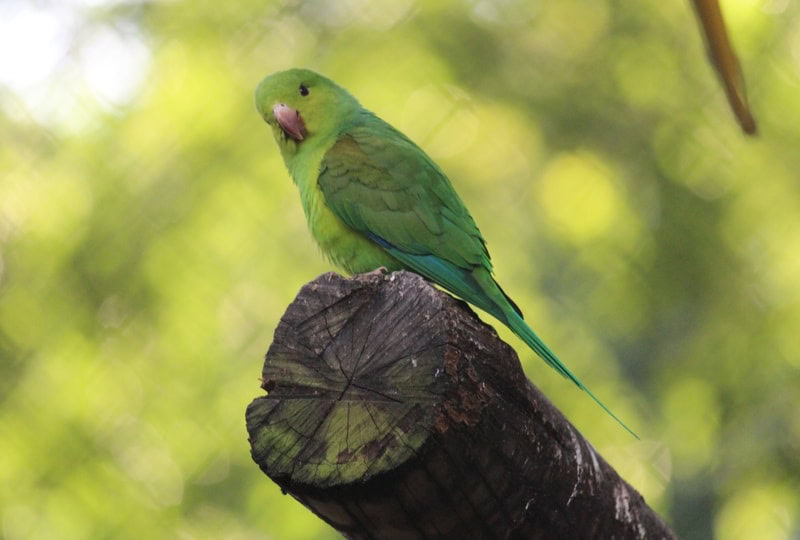
If you’re unsure about Lovebirds, a possible alternative is a parrotlet found commonly in the pet trade, such as the cobalt-rumped parrotlet. These parrots closely resemble lovebirds in size, personality, and general disposition, so much so that they are sometimes referred to as “South American Lovebirds”.
Much like lovebirds, these tiny, feathered individuals seem to be unaware of their relative size and will readily attack much larger pets or birds. Therefore, they shouldn’t be housed with them, as this increases the risk of injury to one or more of your pets.
6. Hahn’s Macaw/Red-Shouldered Macaw

| Cage Size (minimum) | 36 inches (length) x 24 inches x 24 inches Approximately 92 x 61 x 61 cm |
| Cage Bar Space | ½ to 5/8 inch (12–16 mm) |
| Difficulty | Intermediate to Advanced |
Macaws are incredibly popular among bird keepers, and if you’re keen on adopting a macaw, the Red-Shouldered/Hahn’s macaw might be worth looking at. They’re often known as “mini macaws” because they are the smallest of all the macaws. They have distinct red markings on their wings.
They are perhaps most notorious for their vocalizations—their loud shrieks might not be conducive to apartment living or if noise is a concern where you stay.
7. Scarlet Macaw

| Cage Size (minimum) | 60 inches (length) x 36 inches x 60 inches Approximately 152 x 91 x 152 cm |
| Cage Bar Space | 1 to 1.5 inches (22–38 mm) |
| Difficulty | Advanced (with Highly Specialized Long-Term Care Needs) |
Another macaw worth considering as a pet for experienced keepers is the scarlet macaw. These parrots are among the largest of all the macaws and are perhaps best known for their striking red color. Because of their relatively large size, they’re best housed on bird trees or stands most of the time.
When socialized well, they make quite the friendly “gentle giants” and are known to form very close bonds with their caretakers. This complicates plans for your bird if they outlive you, as certain individuals can easily live for over 50-70 years, with some individuals documented to live into their 70s or occasionally longer under optimal care.
Parrots that form close bonds with their keepers are prone to extreme amounts of stress if they’re ever separated due to unforeseen circumstances. For this reason, their designation as a pet remains controversial, as in most cases, they end up outliving their caregivers.
8. Sulphur-Crested Cockatoo

| Cage Size (minimum) | 48 inches (length) x 36 inches x 48 inches Approximately 122 x 91 x 122 cm |
| Cage Bar Space | 1 to 1.5 inches (22 – 38 mm) |
| Difficulty | Advanced (with Highly Specialized Behavioral and Social Needs) |
If cockatiels don’t tickle your fancy when it comes to a cockatoo, the sulfur-crested cockatoo might be the parrot for you. In many parts of Australia, these parrots have adapted exceptionally well to life in the city and are even considered pests. Their success as a species is often attributed to their highly adaptive diet and tendency to mingle with humans for food, even when they’re not kept as pets.
Their longevity rivals that of other large parrots, with an individual named Fred confirmed to be 100 years old in the year 2014. Though the prospect of a long-lived pet might be appealing, much like macaws, their lifespan may pose an ethical dilemma for those who choose to adopt them.
Sulphur-crested cockatoos are highly intelligent and emotionally complex parrots. They are known for their loud vocalizations and intense social demands.
Without extensive daily interaction and enrichment, they are prone to behavioral disorders such as feather-damaging behavior, chronic screaming, and may become aggressive.
9. Eclectus Parrot

| Cage Size (minimum) | 36 inches (length) x 24 inches x 24 inches Approximately 92 x 61 x 61 cm |
| Cage Bar Space | ½ to 5/8 inch (12–16 mm) |
| Difficulty | Advanced (with Specialized Nutritional Requirements) |
For those looking for the fruit connoisseur of the parrot world and an easy-to-sex parrot, the Moluccan eclectus will likely be the best fit for your criteria. The color differences between males and females are remarkable, so much so that they were once thought to be completely different species.
Wild parrots of this species are often considered pests because of their fondness for destroying fruits. As pets, they are no different, readily enjoying a plethora of fruits: mangoes, figs, guavas, melons, citrus fruits, apples, and papaya are just some of their favorites.
Their love for fruits is also the biggest challenge for pet keepers. As pets, they need to consume less sugar because they fly less than their wild counterparts. The lack of exercise in captivity means that the excess sugar in fruits can quickly lead to an overweight pet.
10. Rainbow Lorikeet
| Cage Size (minimum) | 36 inches (length) x 24 inches x 24 inches Approximately 92 x 61 x 61 cm |
| Cage Bar Space | ½ to 5/8 inch (12–16 mm) |
| Difficulty | Advanced (with Highly Specialized Dietary Needs) |
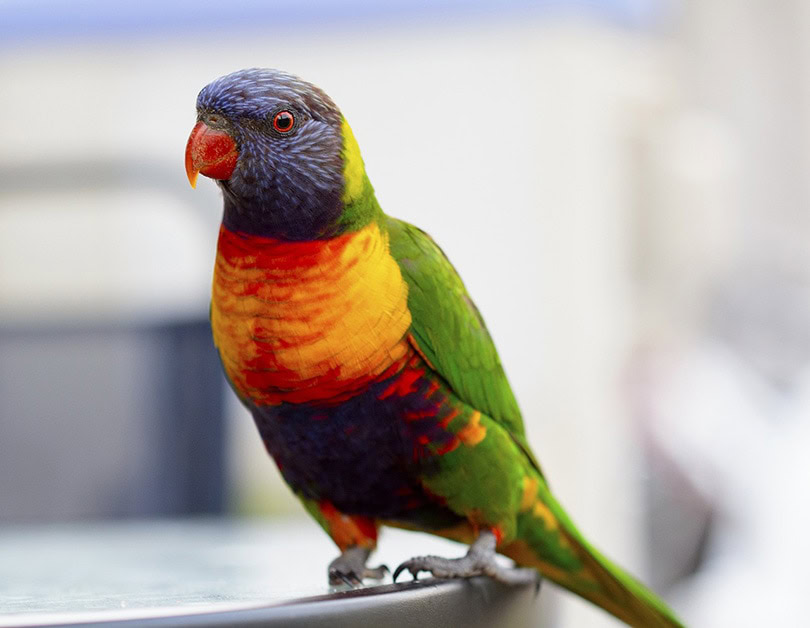
Though most parents dread a picky eater, if you can handle it, the Rainbow lorikeet can surely provide you with the challenge you desire. Once you look past their striking colors, you’ll notice their most unique feature: their tongue. It is specially designed to eat the fleshy parts of fruit and to extract nectar and pollen from flowers. As a result of this unique adaptation, these parrots don’t handle seeds or pellets well, if at all. They are highly specialized in terms of their dietary requirements, which makes them a more challenging pet.
They should not be offered food found outdoors because they are prone to lorikeet paralysis syndrome. This condition is observed in wild parakeets in some parts of the world, where thousands of individuals become paralyzed and seemingly unable to fly or eat.
As this condition is seasonal, the current hypothesis is that it is associated with plant poisoning from an unknown plant that blooms in the seasons when this syndrome is most observed.
A Note About African Greys
We’ve excluded the African grey from our recommendation of parrots. Though they are popular and perhaps best known for their remarkable speech ability and intelligence, their popularity has unfortunately led to a massive surge in illegal trade, threatening their wild populations drastically.
They are also extremely difficult to care for in captivity—up to 40% of pet African greys tend to develop behavioral issues in captivity when their complex environmental and social needs are not adequately met.
Conclusion
The world of parrot keeping offers plenty of choices for beginners and seasoned aviculturists alike. However, parrots are not low-maintenance pets and are not well-suited to every household. Though parrots have unique care requirements and remain controversial as pets, there are nonetheless several species that can be considered for legal adoption by well-prepared, committed caretakers.
We hope this article has helped you narrow down your selection of a feathery companion. As always, if you’re ever in doubt about your pet parrot, your exotic or avian veterinarian should be your first point of contact.
Featured Image Credit: Athit Pradasak, Shutterstock
Contents
- Before You Adopt
- The 10 Popular Types of Pet Parrots
- 1. Budgerigar/Budgie
- 2. Cockatiel
- 3. Rose-Ringed Parakeet/Ringneck Parrot
- 4. Lovebird
- 5. Cobalt-Rumped Parrotlet
- 6. Hahn’s Macaw/Red-Shouldered Macaw
- 7. Scarlet Macaw
- 8. Sulphur-Crested Cockatoo
- 9. Eclectus Parrot
- 10. Rainbow Lorikeet
- A Note About African Greys
- Conclusion