






Click to Skip Ahead
You’ve probably noticed that birds have wings, not front legs or hands. Because of this, they rely on their mouths to help make sense of the world around them. They use their beaks to chew food, climb cages, and crack open hard objects. A bird’s beak is a powerful tool, and while not all pet birds bite, there is a significant difference between a playful nibble and an aggressive chomp. It’s disheartening when our pets turn aggressive without knowing what is causing the behavior. Regardless, owning a bird comes with the risk that you might get bit a few times, and you should understand why they’re doing it and learn how to handle it.

Top 6 Reasons Why Pet Birds Bite
A bird biting you doesn’t always mean that they are trying to hurt you. Birds use their strong beaks for a variety of reasons. It is only when those bites are used for violence that you should be concerned. If you think your bird’s behavior has taken a turn for the worse, here are a few possible reasons.
1. Fear
The most common reason pet birds bite is that they’re scared. Baby birds tend to develop a fear of humans if they aren’t constantly being socialized with them. If you happened to get yours as an adult, they could have an abusive history that taught them that human hands aren’t safe. Even birds that are well-socialized sometimes become frightened. It is crucial to gain your bird’s trust and let them know that they don’t have to fear you or other humans.
2. Young Bird Behavior
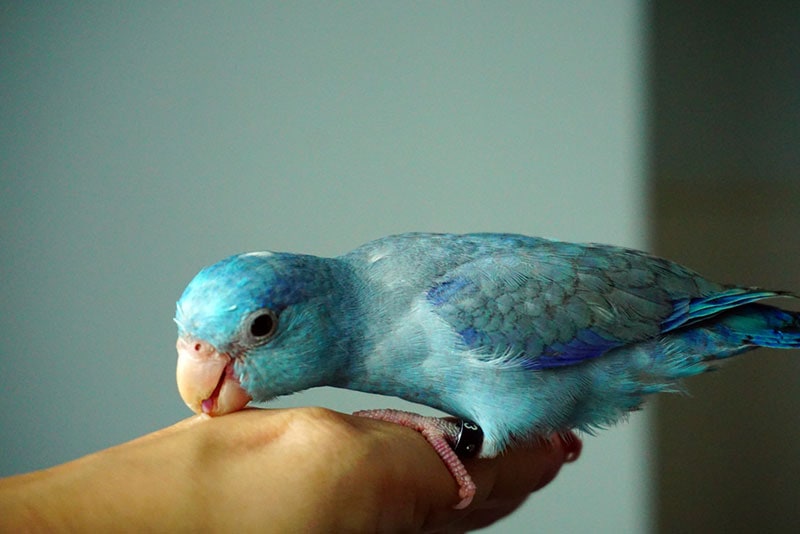
If you have a young bird, it’s likely that they aren’t trying to hurt you at all. Baby birds are similar to children or puppies, and they use their mouths to explore the world around them. Young birds must be taught boundaries. If you don’t have any other birds to teach them that they are biting too hard, then you have to teach them that biting can be painful. If a young bird bites too hard, the best approach is to immediately and gently withdraw your attention. This mimics the way a flockmate might walk away after an unwanted interaction.
Keep in mind that young birds use their beaks to grab onto their owners and climb onto them. If you pull your hand away too quickly, it teaches them that they must move faster and bite down harder the next time. Always move slowly and stay calm when training baby birds.
3. Control
Bird groups almost always have a social structure. Pet birds are no different and use biting as a way to communicate discomfort, defend preferred spaces, or express stress. Territory in the pet bird world is usually their cage or the human whom they are bonded to. Some birds learn that they get what they want when they bite, whether that’s watching you yell from the pain or getting put back in their cage afterward. They might also use biting to avoid things like getting their nails trimmed.

4. Breeding
A lot of sexually mature birds become aggressive when they’re in breeding mode. They act more protective of their mates and are more likely to defend their preferred spaces. The biting behavior could be a phase based on hormonal changes.
5. Medical

Birds get sick just like we do. A pet that doesn’t feel well might bite to let you know that they want to be left alone. However, any changes in your bird’s behavior need to be evaluated by a veterinarian to rule out any serious illnesses or diseases.
6. Playing
It isn’t uncommon for birds to bite here and there during a play session. They get overstimulated and don’t always mean to grasp so tightly that it hurts you. Try to pay attention to your bird’s body language, and cut playtime short if they are getting overexcited or too riled up.

How to Stop Your Pet Bird From Biting
Put your bird’s bad behavior to a stop before it gets out of hand and becomes a habit. The last thing a bird owner wants is to turn a one-time occurrence into a lifetime of painful bites.
1. Determine the Cause
The first step in correcting a biting problem is figuring out why the behavior is happening in the first place. Start by ruling out underlying problems like an illness. Think about where it took place, when it happened, whom it happened to, and what happened right before the bite. If a bird is biting, there is some sort of trigger to this behavior.

2. Redirect to an Alternative Behavior
Make sure that all of your pet’s current needs are being met. They need proper sleep, nutrition, and mental stimulation to keep them happy. It is going to be a lot more challenging to stop the biting if they don’t have all these needs met. Next, consider what behavior you want them to do to replace the biting. Provide consistent positive reinforcement for the good behavior and avoid reinforcing the unwanted behavior. Any form of correction should be gentle and based on removing attention or access to rewards, never punishment. Instead, try to take away something the bird wants, such as your attention or access to a favorite toy, when they act out.
3. Train Them
Birds are intelligent animals, and they have the ability to learn commands, especially when using positive reinforcement methods. To start this process, teach parrots basic commands like “up” and “down” when they move from their perch to your hand. Remember to reinforce good responses with desired consequences, like a seed or a piece of fruit. Parrots are able to learn and respond to visual and vocal cues and they can learn a variety of different behaviors.

4. Practice Short, Daily Sessions
Short sessions are best when teaching birds new commands and should be done away from their enclosure if they have been biting you. They are less likely to bite a human whom they are comfortable with when they are in a neutral or unfamiliar setting. Birds also respond to tone of voice and facial expressions. Lay on a lot of positive reinforcement during these training sessions. When they act out, simply tell them “No” in a calm and neutral voice. Do not yell or talk loudly because they might interpret it as exciting vocalization and become more stimulated. Never use aggression when training your pet birds.
5. Remain Persistent
Daily lessons are vital to stopping bad behavior. Pay close attention to how your pet is responding, and once the behavior is consistently performed, you can gradually end formal training sessions, but continue to use the commands naturally in your daily interactions and environment.

6. Redirect Immediately
If a bite happens again, respond immediately and calmly to discourage the behavior. Safe ways to do this include gently shifting your hand or posture to disengage without startling the bird. Never allow your bird to fall, and avoid yelling, as this can be stimulating or reinforcing. You could also place them in their cage for a time-out, but only if the cage is not being used as a reward or escape from something they dislike.

Final Thoughts
All birds bite at one point or another, and the key to keeping it under control is building trust and a deep bond with your bird. If they start biting out of nowhere, there is likely a reason for it, and you have to evaluate the environment and figure out what is triggering them. Not all biting is aggressive or intentional, so be patient and gentle during the process, and try to keep in mind that they’re only trying to communicate discomfort, fear, or confusion.
See also:
- How to Protect Your Pet Bird From Being Stolen: Tips & Tricks
- Common Beak Problems in Birds to Look Out For
Featured Image Credit : Tracy Starr, Shutterstock